

Food for Thought
The context of this week’s Gospel reading matters a lot. Matthew 18:15-20 is often used to justify church discipline and excommunication of those whom the church power brokers deems a sinner. The common interpretation says that if two or three witnesses agree that the person is a sinner, and the sinner won’t repent, then the two or three witnesses have God’s authority and blessing to kick the sinner out of the church.
Let’s zoom out for a moment before we go directly to that harsh interpretation. Matthew 18 contains the fourth discourse of the five discourses recorded in Matthew. It is the final discourse of Jesus’ ministry in Galilee before he heads to Jerusalem for his trial and execution.
Notice how the discourse begins. The disciples came to Jesus and asked, “Who is the greatest in the kingdom of heaven?” Jesus responded by calling a child to him and directing everyone’s attention to her. He says three things about the child:
- unless you change and become like a child, you will never enter the kingdom of heaven.
- whoever becomes humble like this child is the greatest in the kingdom of heaven.
- Whoever welcomes one such child in my name welcomes me.
He follows up these three points with three metaphors/stories. First, anyone who causes a little one to stumble…woe to them! Second, don’t despise the little one, who is a lost sheep. The shepherd leaves the ninety-nine and seeks it out. Third, (our text) if a brother or sister sins against you, go to them, take others with you, pursue reconciliation. If they won’t listen…treat them like a Gentile and a tax collector. Hmmm, how did Jesus treat Gentiles and tax collectors?
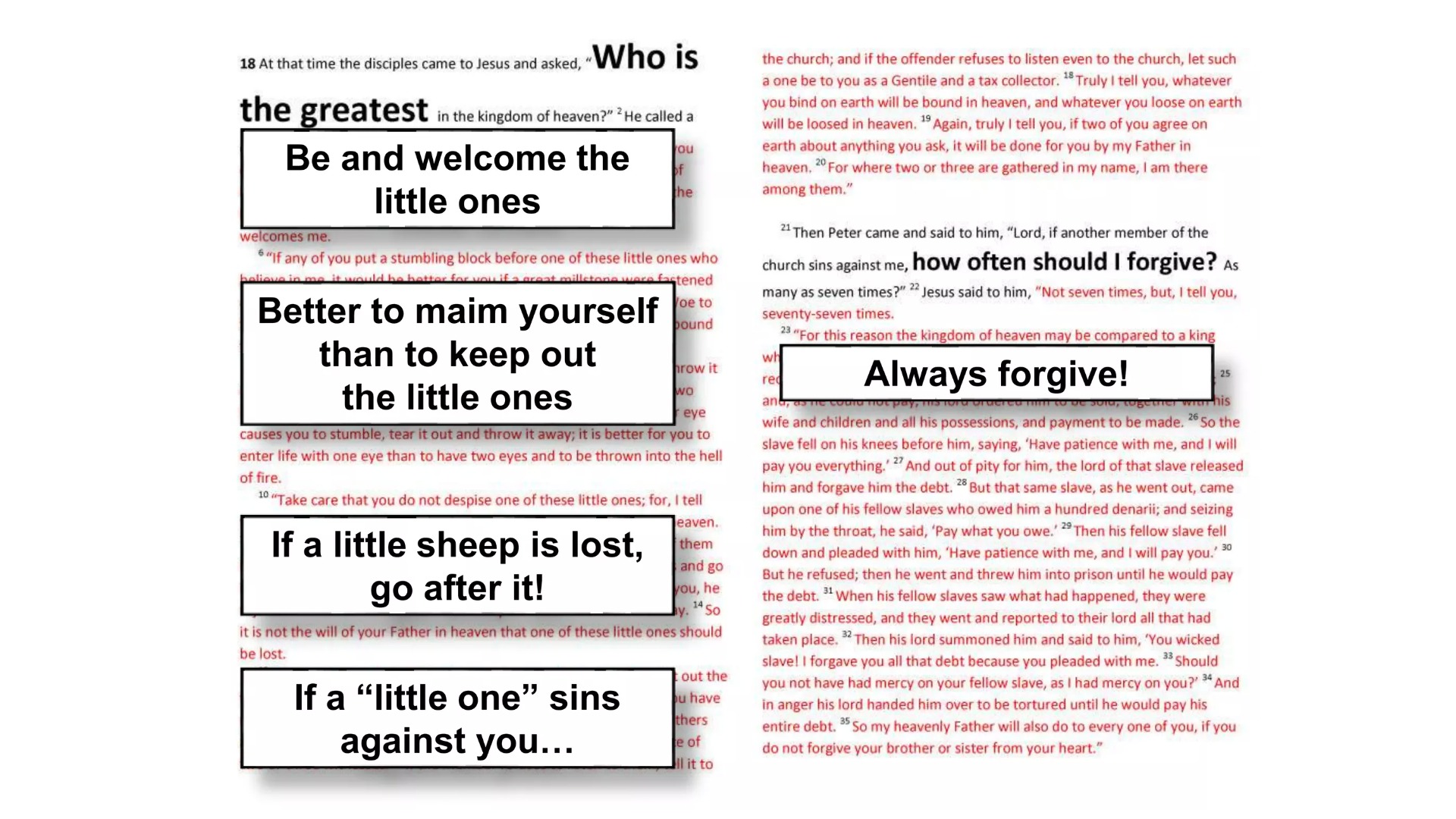
The community discourse continues with Peter asking Jesus, “If my brother or sister sins against me, how often should I forgive? Seven times?” Jesus speaks hyperbolically and says, “seventy times seven!” Jesus then offers the parable of the slave who was forgiven but then won’t forgive.
What is going on with the Community Discourse?
Remember, Jesus is about to place himself into the hands of the most powerful people in his culture. The religious leaders want him dead and the Roman Empire is willing to crucify anyone who is causing trouble. Jesus is about to be unjustly accused by a council of witnesses and bound by them, in the name of God.
Two thousand years later it is easy for people who have power in a church to take our reading today and use it to justify the excommunication of people who make them uncomfortable.
Lets bring the other readings for this week into the mix. The Ezekiel text says that God’s desire is not punishment, but restoration. The Psalmist’s desire is to follow the ways of God. Paul tells the Romans that “love is the fulfilling of the law.”
What if Matthew 18, Jesus’ discourse on community, is not intended to root out the sinners among us. What if it is a call for humility, patience, and the pursuit of forgiveness and reconciliation as the highest priority for the the disciples of Jesus?
read all the commentaries and get downloads HERE.
Food for Thought
We come to the fourth and final week of our series on the Ten Commandments. The text is just one verse. Exodus 20:17 says, “you shall not covet…” then lists all the things your neighbor owns.
The Hebrew word is hemed. It literally means “delight” or “take pleasure.” When Eve saw the forbidden fruit hanging from the tree of the knowledge of good and evil, she hemed it. She took delight in it and took it for herself.
Taking delight in something is not wrong. The lover takes delight in the beloved in the Song of Solomon. God delights in us.
The prohibition here is to take delight in something that doesn’t belong to you. If your neighbor has something that you really like and you wish you had, what do you do? You have three basic choices.
-
ignore the situation and pretend like you don’t notice how nice the thing is. This may lead you to become alienated from your neighbor.
-
seethe with envy over the fact that your neighbor has it and you don’t. This negative delighting may lead you to kill, commit adultery, steal, lie (hey, those sound familiar!)
-
Rejoice with your neighbor that they have good things and give thanks to God for the things you have.
The antidote to covetousness is contentment with gratitude. It is a difficult heart space to inhabit when we live in a society that constantly bombards us with the message that you are “less-than” if you don’t own this product or achieve a certain status in life with the “smokin’ hot spouse” walking beside you.
Let us breathe together this week and give thanks to God for all the gifts we have, and rejoice with our neighbor for the gifts they have. Maybe we can share.
Read all the commentaries and get downloads HERE.

Every week I compile all the visual resources on cartoonistbible.com for the lectionary readings on both the Revised Common Lectionary and the Narrative Lectionary. Get them in your inbox every Monday morning.