
Welcome back to another session of our summer journey through Art and Scripture here at Art Pastor Live! If you are joining us for the first time or returning as a regular visual pilgrim, I am so glad you are here.
In a world dominated by flash-bang social media algorithms, hyper-fast AI image generators, and relentless “bigger, better, faster, stronger” demands, Art Pastor Live is my small, intentional attempt to swim against the current. The goal is simple yet countercultural: to slow down, spend an hour together in real time, contemplate the Word of God, and create a piece of art completely from scratch.
Slowing Down for “Holy Wasted Time”
As a pastor in the ELCA, a visual artist, and professor of spiritual formation at Luther Seminary (where I also serve as dean of the chapel), I often remind my students and community that contemplative practice is ultimately a “holy waste of time.” It is an invitation to step out of the productivity trap, sit quietly, and simply enjoy God’s presence. When I grab my Apple Pencil and paint live on screen, I am not trying to perform; I am playing with my Creator and offering the gift of visual creativity back to the One who gave it to me.
In our latest session, we explored two passages from the Revised Common Lectionary for this week: Isaiah 55:1–5 and Matthew 14:13–21. On the surface, these passages celebrate bountiful banquets and miraculous feedings. But when we look closely at their historic and narrative contexts, we discover a striking truth: God’s abundant feast is almost always proclaimed in the deepest shadows of grief and tyranny.
walking through the session…
Part 1: The Feast of Isaiah 55—Hope in Babylonian Exile
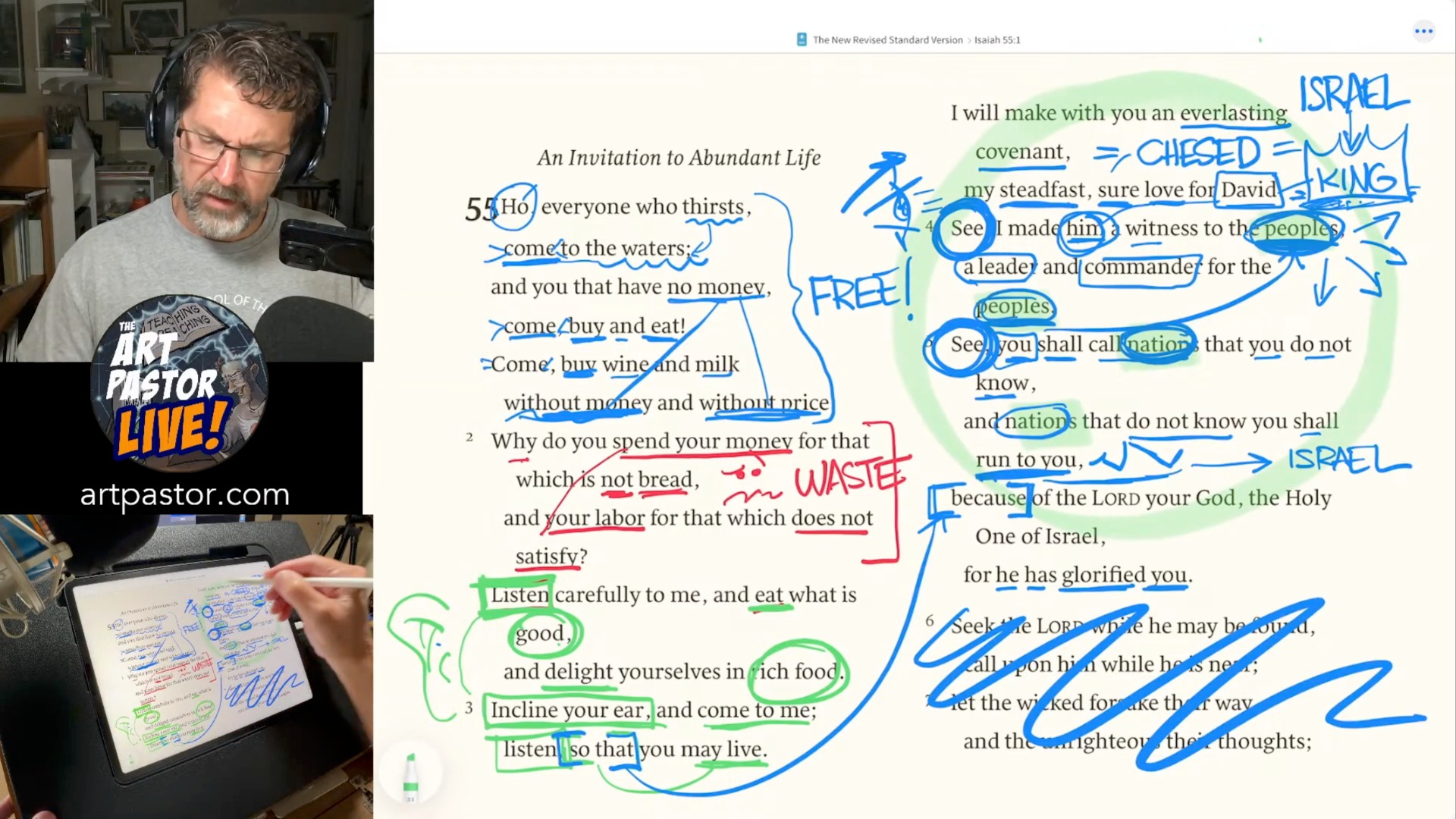
“Ho, everyone who thirsts, come to the waters; and you that have no money, come, buy and eat! Come, buy wine and milk without money and without price. Why do you spend your money for that which is not bread, and your labor for that which does not satisfy?” — Isaiah 55:1–2
During the live stream, I opened up Logos Bible Software on my iPad Pro and pulled out the screen-drawing tool to unpack the Hebrew poetry of Isaiah 55. Hebrew poetry relies heavily on parallelism—paired lines that mirror, expand, or contrast one another.
Notice who Isaiah is addressing first: “Everyone who thirsts… you that have no money.” This is an open invitation to the destitute. God offers a feast of rich food, wine, and milk entirely free of charge. But then the prophet turns to a second group and asks a sharp question: “Why do you spend your money for that which is not bread, and your labor for that which does not satisfy?” It is a tragic waste—spending finite human energy on things that leave the soul empty.
The context here is critical. Isaiah 55 was written during the Babylonian Exile—one of the darkest, most devastating eras in Israel’s history. Jerusalem was shattered, the Temple lay in ruins, and God’s people were living as captives in a foreign land. It felt like all hope was erased. Yet right in the middle of exile, God speaks a promise of hesed—that steadfast, unshakeable covenant love given to David and Abraham. God reassures Israel that the story is not over. Nations will yet run to them because of the Lord’s enduring faithfulness.
Part 2: Matthew 14—Grief, Compassion, and 12 Baskets Left Over
Moving into the Gospel reading, we find the familiar story of Jesus feeding the 5,000. We often remember this story as a cheerful Sunday school miracle involving two fish and five loaves. But when you read Matthew 14 sequentially, the setting is heartbreaking.
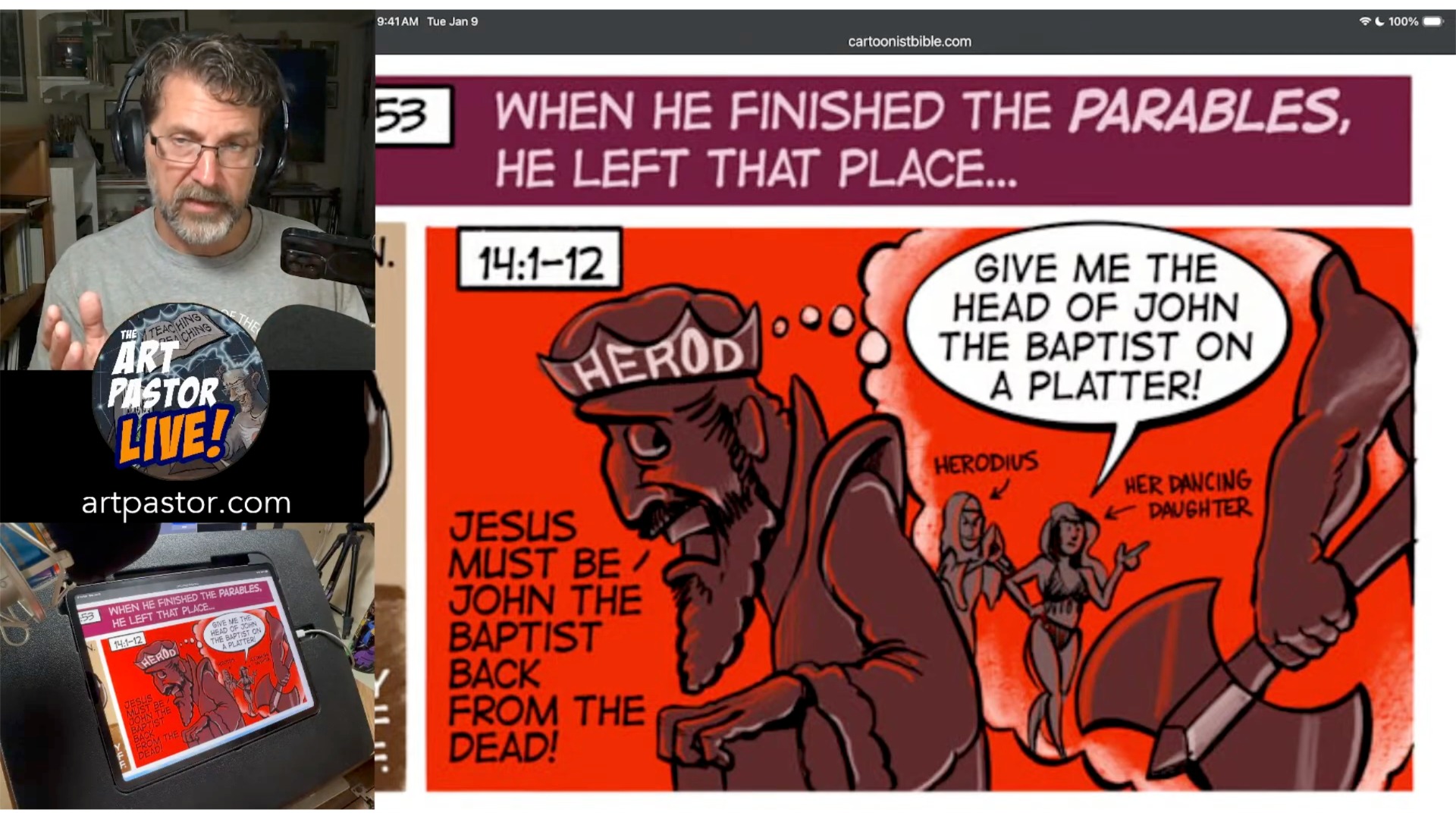
Right before verse 13, Matthew tells us about King Herod’s grotesque, corrupt birthday party. In a drunken display of vanity and fear of losing face, Herod orders the execution of John the Baptist—Jesus’ cousin, friend, and fellow prophet—and has his head delivered on a platter. It is a terrifying abuse of political power and human tyranny.
“When Jesus heard what had happened to John, he withdrew by boat privately to a solitary place.” — Matthew 14:13
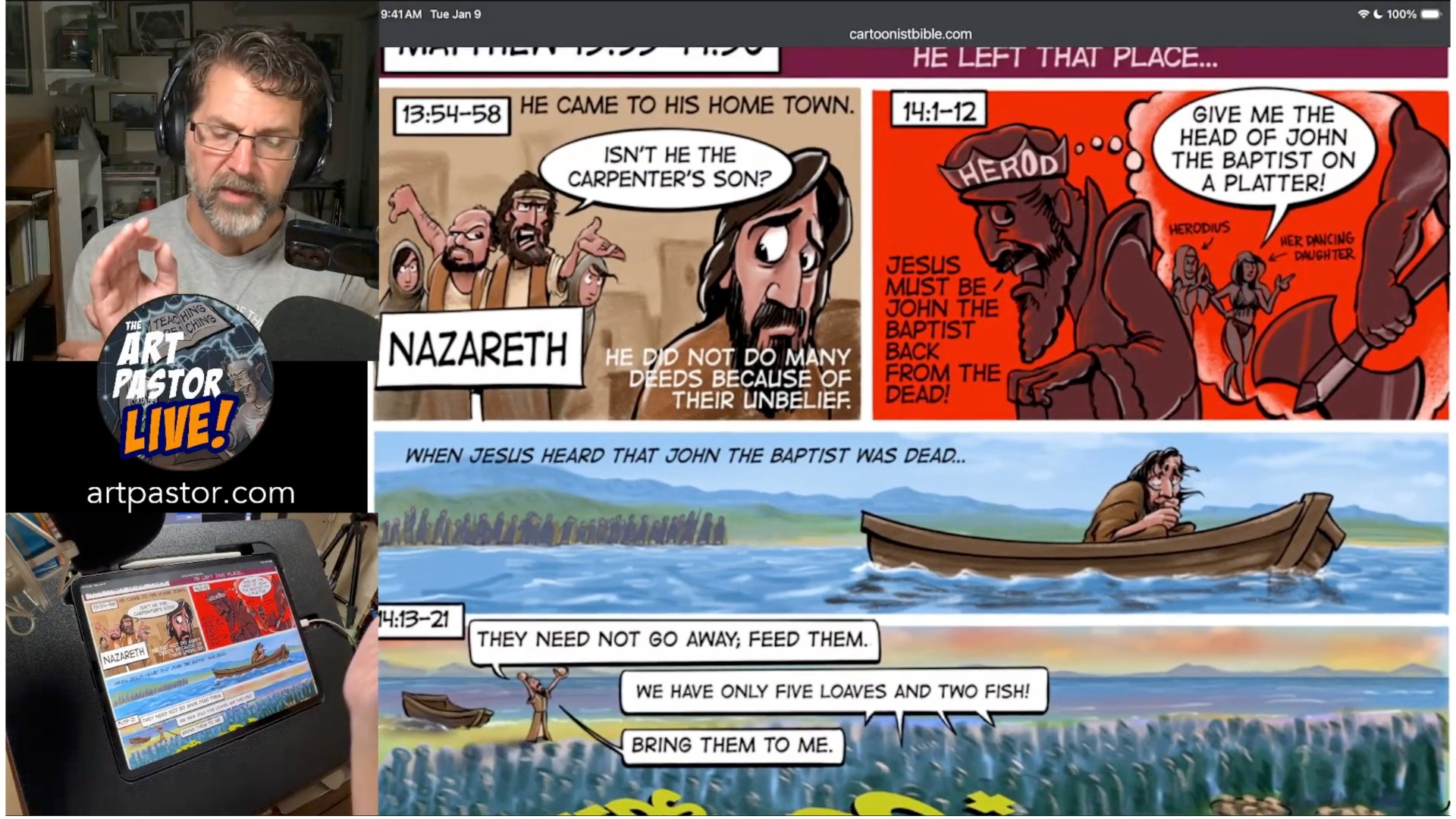
Jesus is processing profound grief. He has just been rejected in his hometown of Nazareth, his cousin was brutally murdered, and he knows the cross lies in his own future. He gets on a boat to be alone. But as the boat drifts toward the shore, thousands of hurting, hungry people run along the coastline waiting for him.
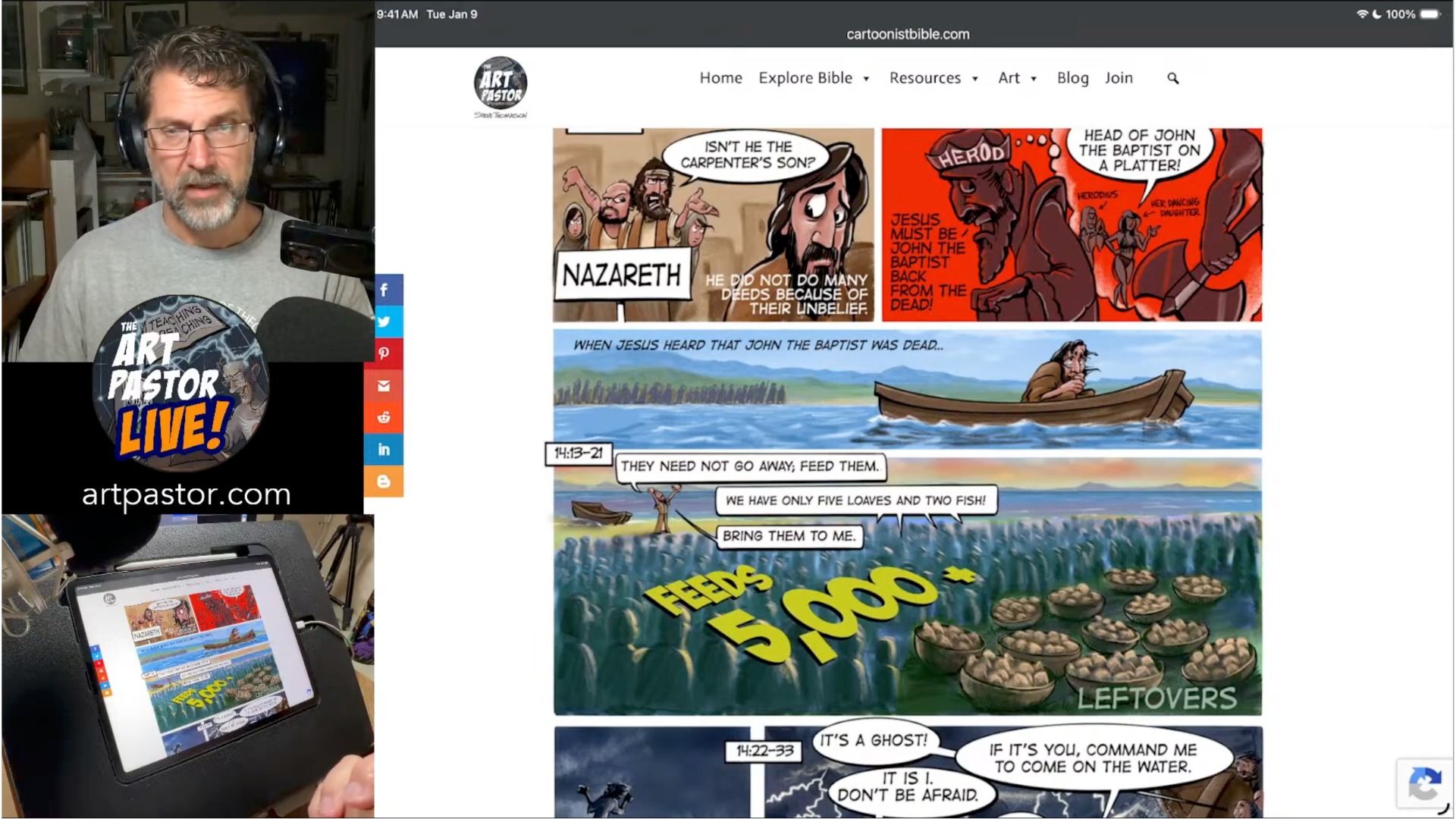
When Jesus steps off the boat, he doesn’t turn them away. The Greek text says he felt splagchnizomai—a gut-wrenching, visceral compassion in his physical core. Out of his own grief and exhaustion, Jesus heals their sick and turns five loaves and two fish into a banquet that satisfies over 5,000 men, women, and children. And when everyone had eaten their fill, the disciples gathered up 12 baskets of leftover bread.
The Core Realization:
In the shadow of Herod’s violent, tyrant feast—a table defined by death, lust, and self-preservation—Jesus establishes a divine counter-table defined by life, grace, and limitless generosity. Where human powers deal in scarcity and violence, God provides overflowing abundance.
Part 3: Bringing the Text to Life on Canvas
After engaging our minds with Scripture, we shifted into our hearts, bodies, and hands during the second half of the live session. Opening the Procreate app on my iPad, I let the visual reflection flow organically without pre-planned sketches.
-
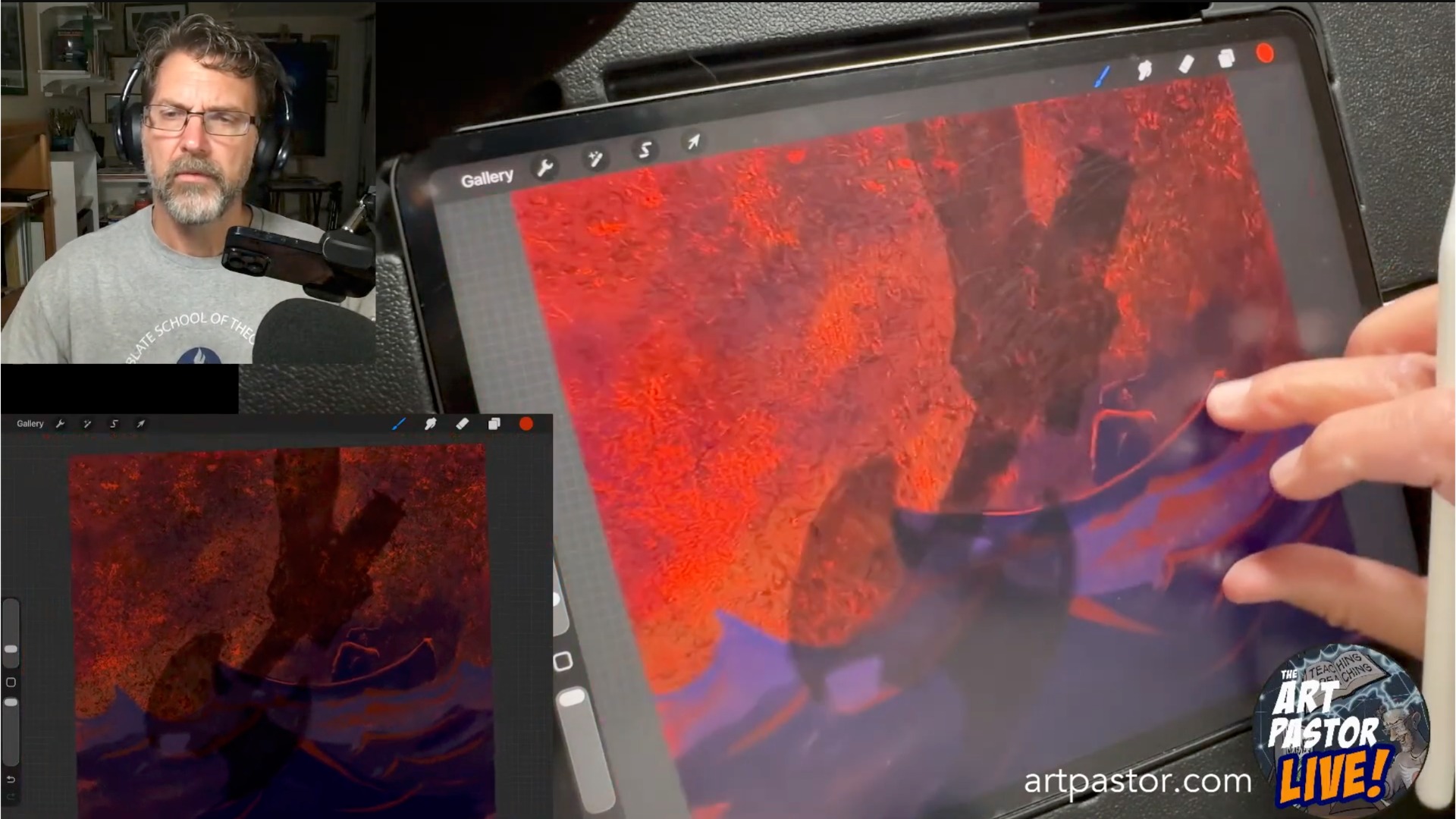
The Shadow of Tyranny & Grief: I began with the heavy, visceral emotion of Herod’s tyranny. Using dark charcoal, deep blues, and harsh crimson accents, I depicted a figure hunched over in a tiny boat tossing on stormy waves—capturing Jesus’ deep grief and isolation. Over top, a faint executioner’s hand held an axe, embodying the oppressive shadow of worldly powers.
-
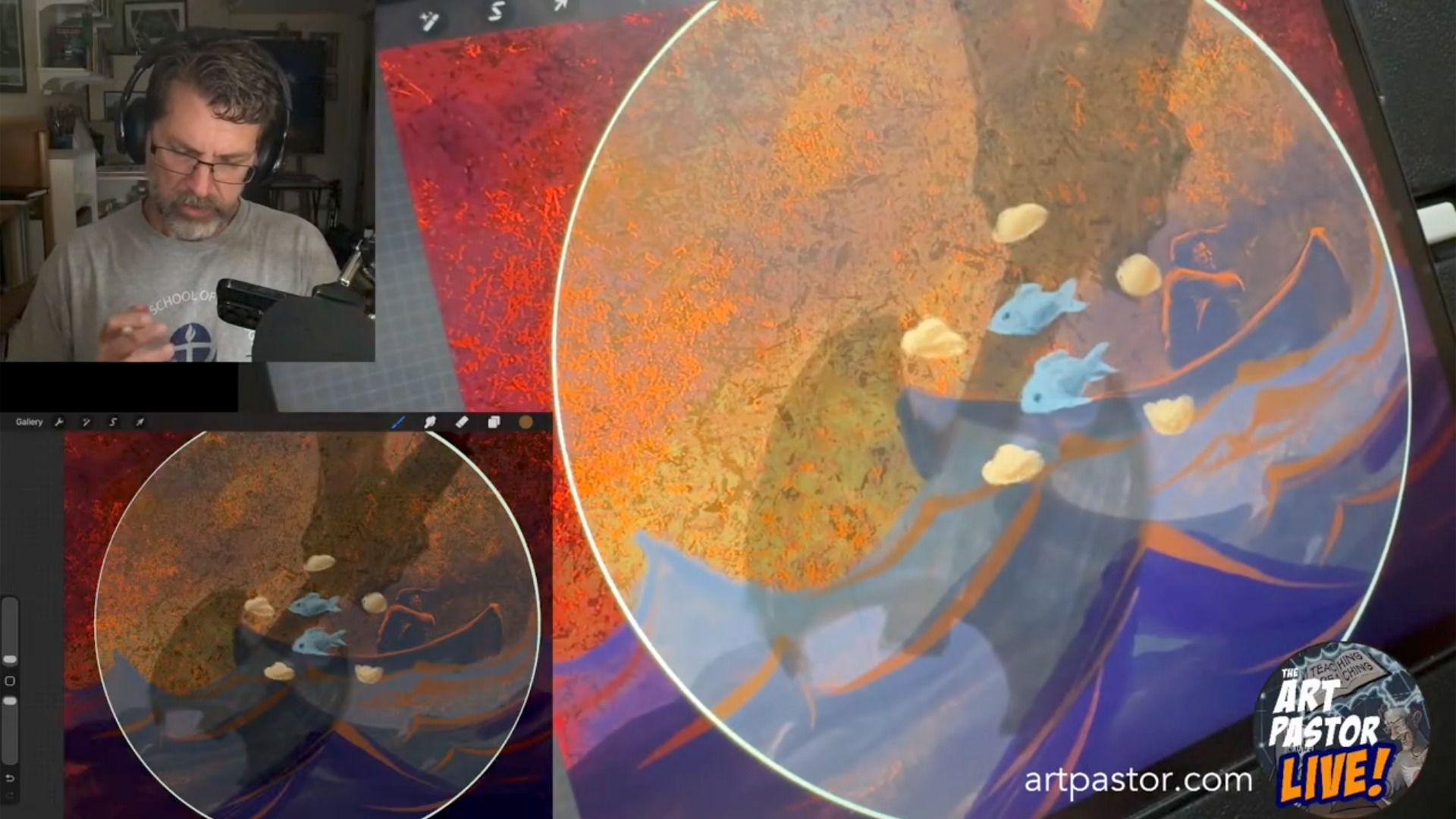
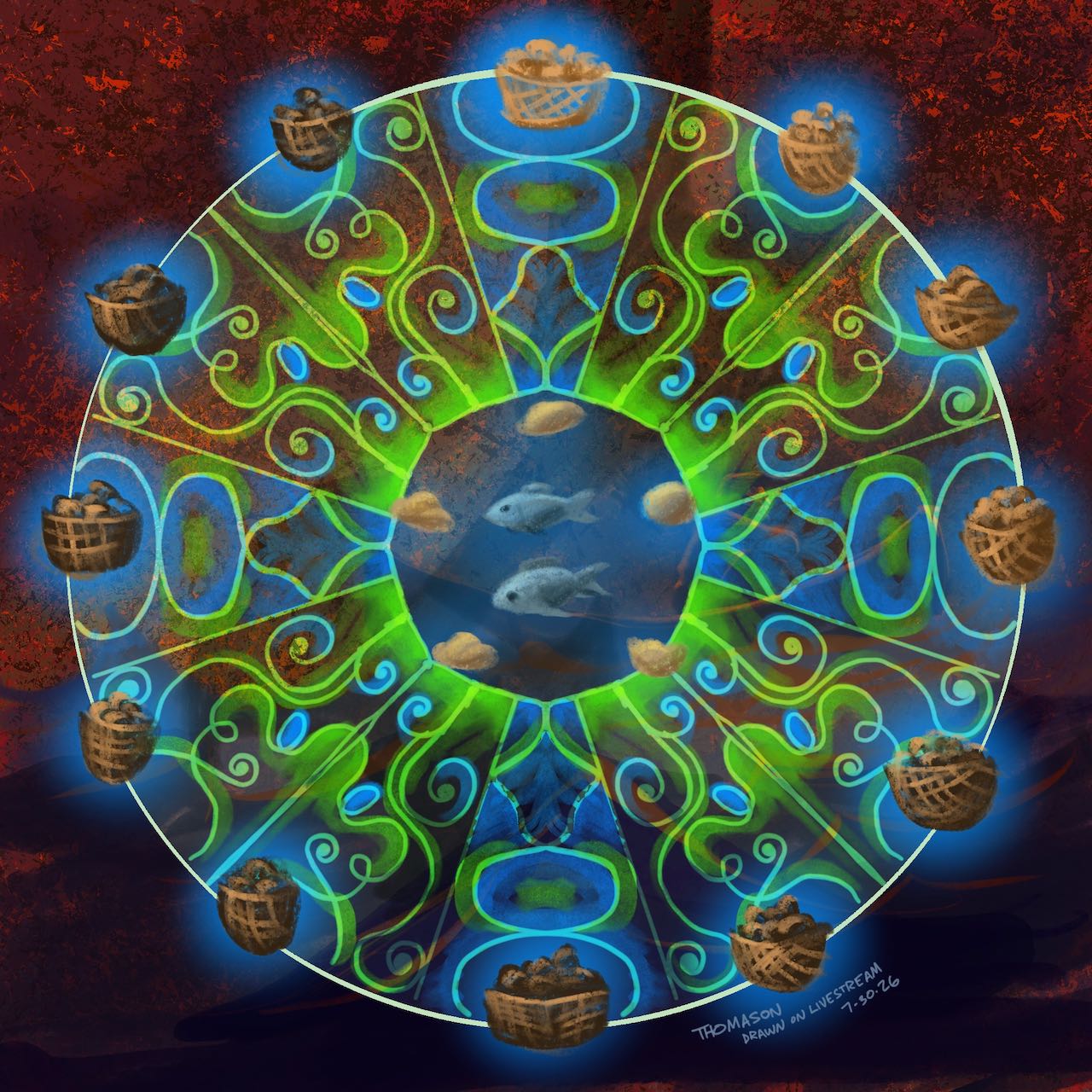
Two Fish & Five Loaves: Moving to the center with a creamy, textured colored pencil brush, I rendered two fish and five loaves of bread in warm, golden tones—representing the modest human offering placed into Christ’s hands.
-
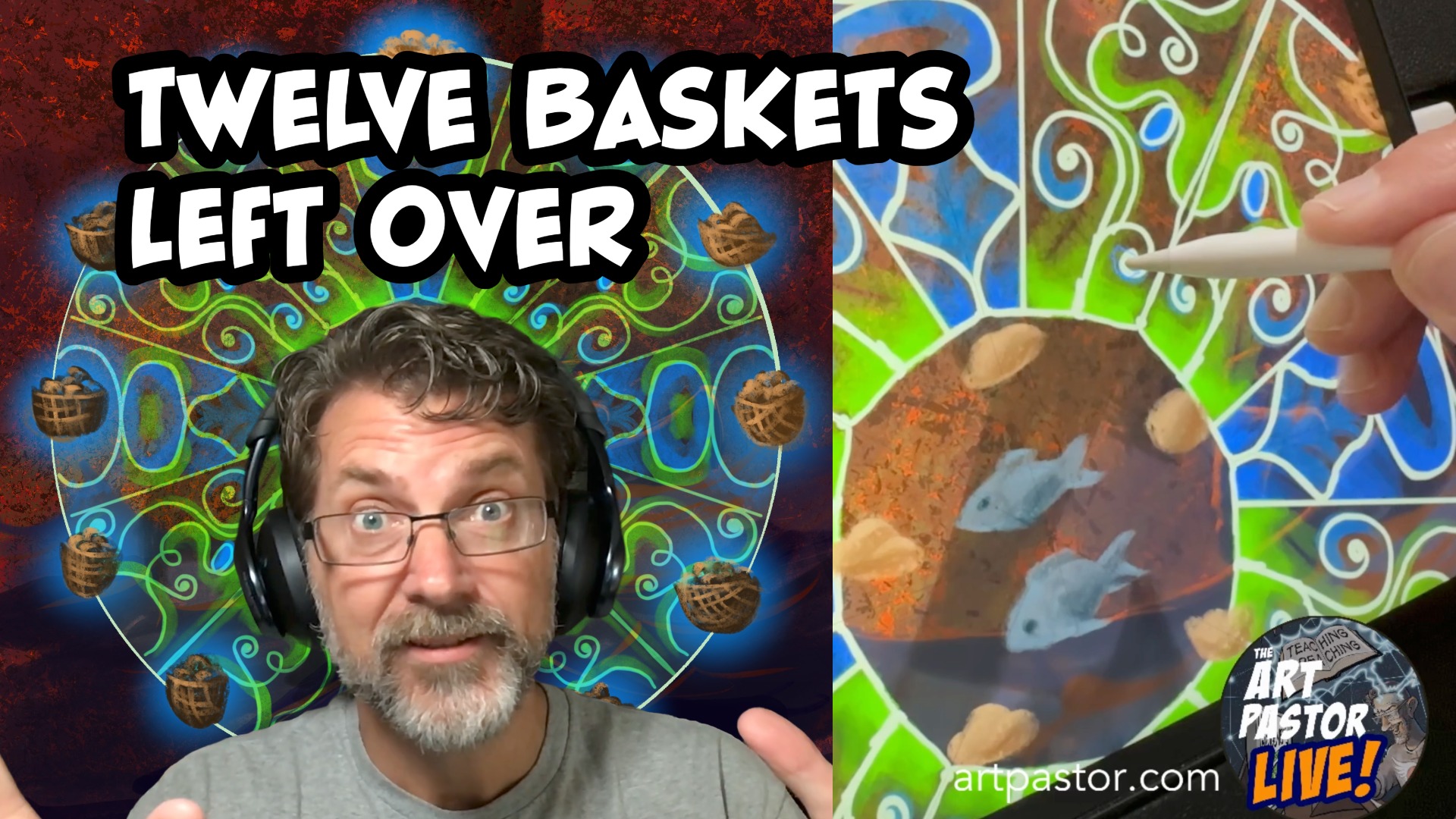
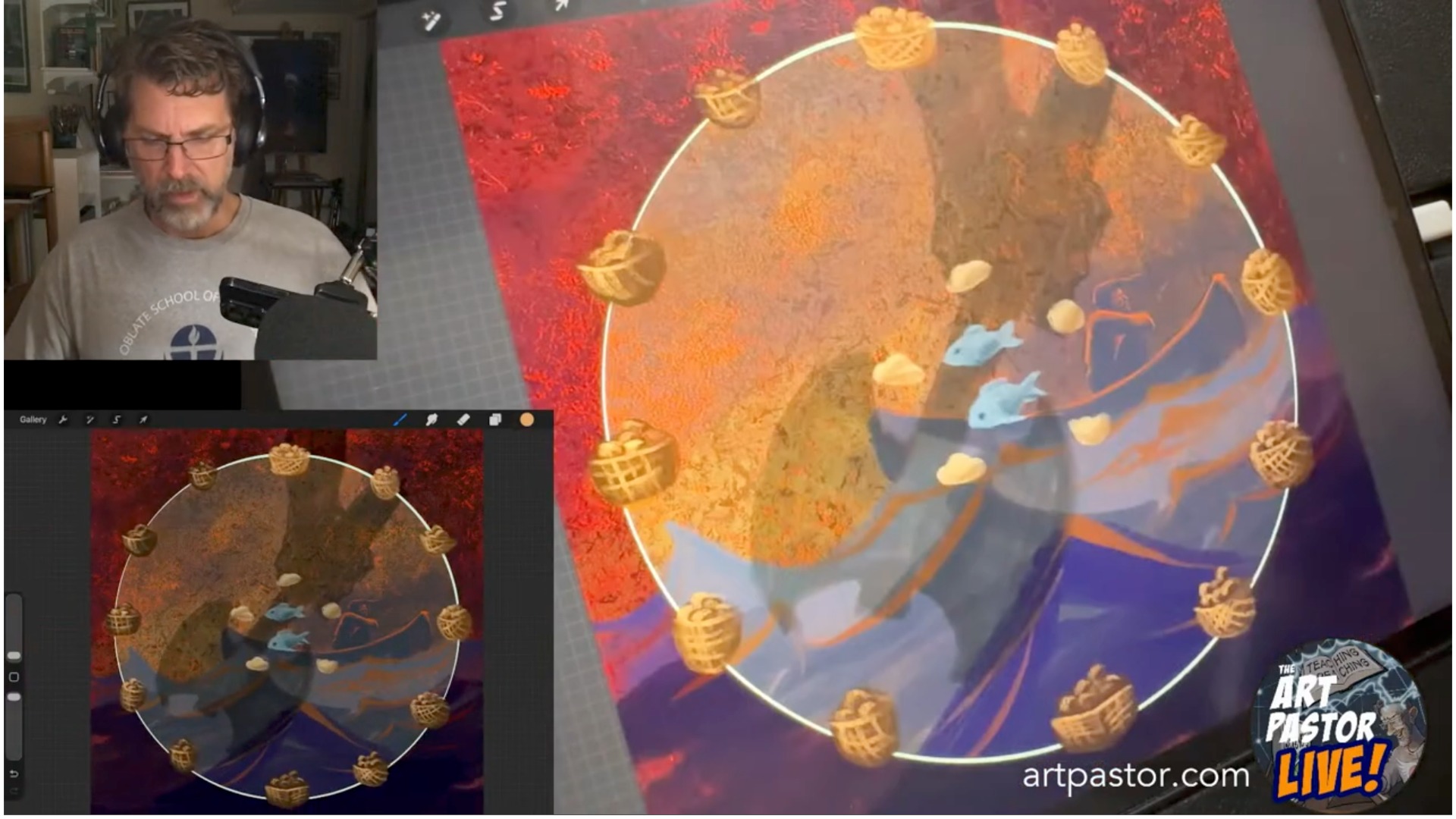
12 Hand-Drawn Baskets: Arranged in a clock-like radial circle surrounding the meal, I drew 12 distinct baskets—symbolizing completeness, the 12 tribes of Israel, and God’s provision across all hours of time.
-
Living Waters & Light: Using Procreate’s radial symmetry, I wove rich teal and emerald lines flowing outward from the food—drawing directly from Isaiah 55’s invitation: “Come to the waters!”
The final artwork—entitled “Twelve Baskets Left Over”—stands as a visual testament that no matter how dark or oppressive the world may seem, God’s meal of grace can never be contained or overcome by fear.
Join the Conversation at Art Pastor Live
I want to give a special shoutout to Denise from Tampa and Bryan on Facebook for chatting along live during the stream! If you missed the live broadcast, you can watch the full replay video right here on this page.
Whether you are a seasoned visual artist, a doodler in the margins of your Bible, or simply someone who hungers to slow down and sit in God’s presence, you are always welcome here. Grab your art supplies, turn on your favorite contemplative music, and join us for our next session.
Want to share the artwork you created during this session?
Come join us inside the Art Pastors Network. It’s a safe, encouraging community where we share our creative worship responses, ask questions, and encourage one another on the journey. There are no critiques or art competitions here—just pure joy and community.

This is my chance to invite you into my studio, talk about the fusion of art and theology, explore spirituality and scripture through visual art, nerd out about the Bible and Visual art, and just hang out with you.

