
Food for Thought
The Gospel reading is a parable that Jesus tells about a generous landowner who pays all the workers a full day’s wage, even if they only worked in the last part of the day. Those who worked all day grumbled and thought the landowner was unfair.
The NRSV translates his response, “are you envious because I am generous?”
The preacher could be led to preach about unjust economics from this text, and that would be appropriate. However, I think the meaning of this passage goes even deeper than that.
The literal translation of the landowner’s response reads, “is your eye evil because I am good?”
I’m not sure this is about envy.
The “evil eye” is an expression in the ancient world that had multiple meanings. Jesus talked about it in the Sermon on the Mount in Matthew 6:22-23. “if you have an open/generous eye, your whole body is full of light. If you have an evil eye your whole body is full of darkness.”
The ancient world viewed the eye as the gateway of thinking and morality. This was not about a medical condition of blindness. This is what we would call a moral problem or “heart condition” of viewing others with contempt.
The context for our Gospel reading this week is very important. Matthew 20:1-16 is a parable Jesus tells within a string of stories that happen in chapters 19 and 20. Jesus is traveling from Galilee to Jerusalem. This is Matthew’s version of the Travel Narratives that the Gospel of Luke takes ten chapters to explore.
I think it is important to look at all of these stories together in order to understand the meaning of the evil eye.
- It begins in 19:1 with the Pharisees challenging Jesus about the law regarding divorce. Jesus elevates women and offers them honor and protection.
- The next story elevates children and offers them honor and protection.
- The next story (our text) challenges the privilege of wealth and calls the wealthy to humility and generosity.
- The next story is Jesus reminding his disciples that he will be tortured, crucified, and rise again.
- The next story is the mother of James and John asking Jesus to exalt her boys. Jesus responds by a call to servanthood. The final story is Jesus having compassion on two blind men when they ask him for healing. They can see and they follow him.
Do you see a pattern? Jesus is turning the social hierarchies upside down. We might think of these two chapters as case studies of the generous eye vs. the evil eye from Matthew 6. How do you view “the least of these?” Do you think that your place of privilege in the eyes of society offers you special standing with God? That view of humanity is the evil eye.
Jesus invites us to view the world through generosity. When the eye is open and generous, when we see all people the way that God sees them, when we understand that those who have power are called to serve those who don’t, when we strive to make sure that even the lowest of the low are valued and protected, no matter the cost, then we will see the Kingdom of Heaven.
May we have open eyes this week.
Food for Thought
The call of Abram in Genesis 12 is a familiar and foundational text to understand the rest of the Old Testament. God makes a promise—a covenant—with Abram to bless him and make his family into a great nation through which all nations will be blessed.
Abram is blessed to be a blessing. That will preach.
Sarai is barren, so to believe that God would make a great nation from their family is an outrageous ask. That will preach.
I’ve preached those things many times, and will continue to do so. This week, however, something different captured my imagination.
Have you ever wondered, “Who is this Abram character and why does he matter in the story? What did God call him to move west and go to the land of Canaan?”
To answer that, let’s look at chapter 11. Two things matter in this chapter. First, the direction the people are moving. Second, the genealogy of Noah’s son, Shem.
First, the people who lived after the flood are moving eastward. Moving east is a negative direction in this story. Remember that Adam and Eve were exiled and sent “east of Eden?” The people in chapter 11 moved eastward and built the tower of Babylon. This tower was a symbol of the uncreation of God’s good creation.
It is important to remember that the people who are editing this story and compiling it into the Bible are people who had just spent 70 years in exile in the Empire of Babylon and Persia. The exiles want to return to Jerusalem. They want to move west because the Babylonians captured them and took them east of Jerusalem.
Second, the descendents of Shem are part of God’s work of recreation. We walk through multiple generations until we come to Terah.
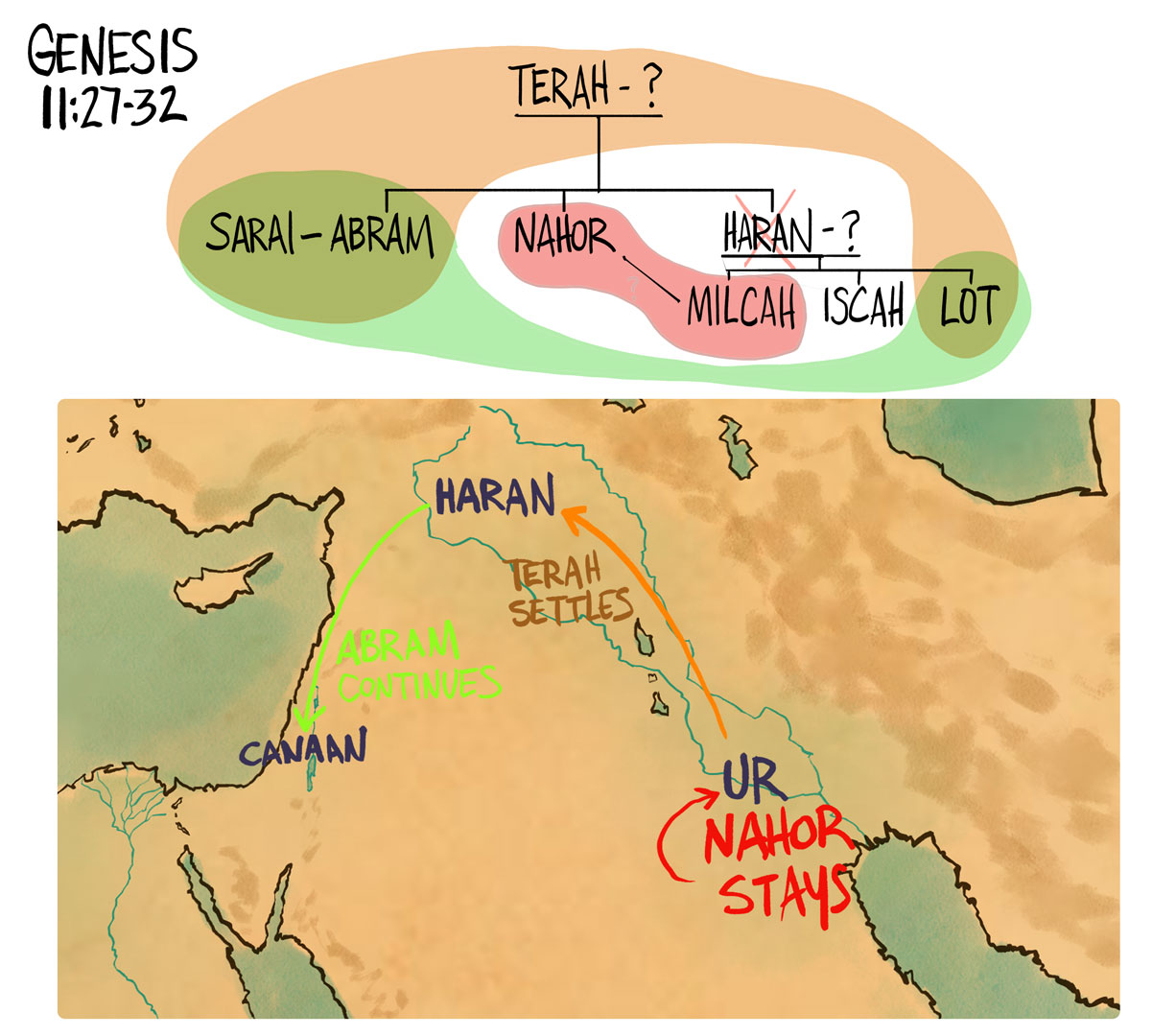
The details of Genesis 11:27-32 matter.
- Terah had three sons: Abram, Nahor, and Haran.
- Haran had a son named Lot, and then Haran died.
- Nahor married his niece, Milcah, the daughter of Haran.
- Abram married Sarai, and she was barren.
- Terah took Abram, Sarai, and Lot and and started moving to the the land of Canaan.
Why did Terah take Abram and not Nahor? Was Nahor’s marriage to his brother’s daughter scandalous?
Notice where Terah stops: The land of Haran, his dead son’s land. This is the son whose daughter Nahor married.
When they came to that land, they settled.
It is in this context that God comes to Abram. “Get up Abram! Leave the land of your father. Stop settling and keep going to the place that I will show you.”
Abram took his wife Sarai and his nephew Lot and continued the journey that his father started.
When they arrived in Canaan Abram called on the name of the LORD.
We often focus on the barrenness of Sarai and the outlandish promise to make a great nation out of a couple who cannot have children. True, that is a HUGE part of this story.
This time through the story, I am struck with the idea that Terah settled. He found a place that worked and gave up the journey.
What does it mean for us to settle? In what ways might God be asking us to be like Abram? To leave the settling of our family system and venture out into the scary places of faith and the unknown in order to be obedient to God’s call?

Every week I compile all the visual resources on cartoonistbible.com for the lectionary readings on both the Revised Common Lectionary and the Narrative Lectionary. Get them in your inbox every Monday morning.