
Participatory Action Research Methodology
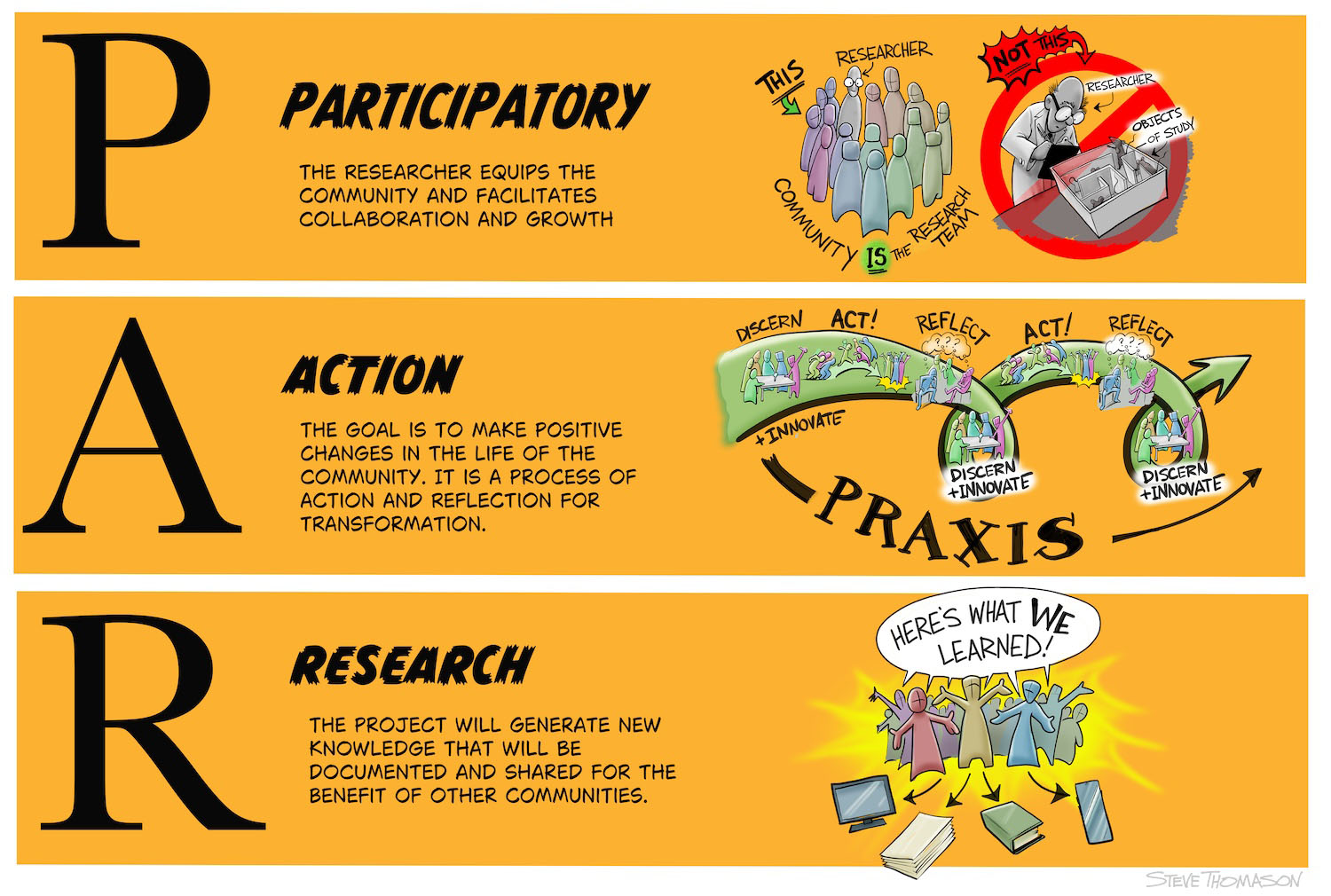
What is PAR?
PAR has its roots in the work of Paulo Freire and the Pedagogy of the Oppressed[3]. It “originated as a challenge to positivist research paradigms.”[4] It is also built upon the Critical Social Theory and communicative rationality taught by Jürgen Habermas.[5]
PAR seeks to understand and improve the world by changing it. At its heart is collective, self reflective inquiry that researchers and participants undertake, so they can understand and improve upon the practices in which they participate and the situations in which they find themselves. The reflective process is directly linked to action, influenced by understanding of history, culture, and local context and embedded in social relationships. The process of PAR should be empowering and lead to people having increased control over their lives.[6]
There is a certain irony that I would choose PAR to work with a group of white, middle-class, suburbanites. Hall notes that the first point of PAR is that it “involves a whole range of powerless groups of people—exploited, the poor, the oppressed, and the marginal.”[7] The members of the RT were anything but poor, powerless, or marginalized. Why then, did I choose PAR to pursue this research question? Herein lies a theological prejudice on my part. It is my argument that the churched-culture of the suburban ELCA congregational context is one that has inherited hegemonic tendencies in the area of theology and practice. The inherited church hierarchy and pedagogical methodologies have fostered a pastor-centered ecclesiology that, I would argue, has oppressive tendencies for the congregational members. While the RT members were not oppressed in a socio-economic perspective, they have been oppressed ideologically through ecclesiastical structures. PAR allowed me, as a representative of that hierarchical power structure, to facilitate an emancipatory space that offered the RT the opportunity to experience liberative thought in theological and ecclesial matters. This, I would argue, is a necessary process for the missional imagination to take root in the suburban ELCA congregation.[8]
How Does PAR Work?
PAR is participatory, it is action, and it is research. PAR is participatory in that the lead researcher is an active member of the group, participating fully in the process of collaborative meaning-making. It is action in the sense that the methodology is built upon the praxis cycle of action-reflection-action. The group discusses a relevant issue, dreams new dreams around the issue, takes action based upon new ideas, reflects upon the action and the implications of the action, reconfigures the ideas based upon the reflection, engages in new forms of action, reflects again, and so on. It is research in the sense that the team reflects upon the process in light of the larger conversation of scholarship around the issues and articulates the newly constructed knowledge through scholarly media for the benefit of the larger academic community.[9]
PAR was especially appropriate for my research question because of its pedagogical implications. My evolution away from a modern, objectivist, teacher-centered pedagogical model made it important that I did not use an “expert,” lecture-style teaching method to present the social Trinity to the group.[10] There was a time in my life when that would have been my default mode of approaching this task. However, part of the way in which my encounter with social Trinity impacted my ideation and praxis of spiritual formation (and pedagogical methodology) was to realize that the process of human knowing and formation is a communicative act that flows within relational ontology. Therefore, the methodology itself was, in my opinion, an experience of the relationality of the Triune God, humanity, and all creation.
My desire to dissuade my propensity to instrumental reason, and to embody the relationality of the social Trinity made it necessary, therefore, to construct a methodological design around the pedagogical models of Parker Palmer and Stephen Brookfield; the cognitive-developmental model of Robert Kegan; and the community-building model of Peter Block. I had to design a space in which members of the RT could feel safe and welcome, and in which they could feel the freedom to process ideas and issues without fear of judgment. I also had to design a way to observe the data generated by the RT to discern the type of impact that the project had on the team.
Footnotes
[1] There is a debate among action researchers as to the nature and purpose of action research and participatory action research. See David Deshler and Merrill Ewert, “Participatory Action Research: Traditions and Major Assumptions,” http://actmad.net/madness_library/POV/DESHLER.PAR.
[2] See the Trinity Frame in chapter three.
[3] Paulo Freire, Pedagogy of the Oppressed, 30th anniversary ed. (New York: Continuum, 2000).
[4] Budd L. Hall, “In from the Cold? Reflections on Participatory Research from 1970-2005,” Convergence 38, no. 1 (2005): 18.
[5] Jürgen Habermas, The Theory of Communicative Action, 2 vols. (Boston: Beacon Press, 1984); The Philosophical Discourse of Modernity: Twelve Lectures, Studies in Contemporary German Social Thought (Cambridge, MA: MIT Press, 1987).
[6] Fran Baum, Colin MacDougall, and Danielle Smith, “Participatory Action Research,” Journal of Epidemiology and Community Health 60, no. 10 (2006). See also ibid; Marlyn Bennett, “A Review of the Literature on the Benefits and Drawbacks of Participatory Action Research,” First Peoples Child & Family Review 1, no.! (2004); Elizabeth Conde-Frazier, “Participatory Action Research: Practical Theology for Social Justice,” Religious Education 101, no. 3 (2006); Deshler and Ewert, “Participatory Action Research: Traditions and Major Assumptions”; Hall, “In from the Cold? Reflections on Participatory Research from 1970-2005; Mary E. Hess, “Collaborating with People to Study “the Popular”: Implementing Participatory Action Research Strategies in Religious Education,” Religious Education 96, no. 3 (2001); Christine Lynn Norton et al., “Reflective Teaching in Social Work Education: Findings from a Participatory Action Research Study,” Social Work Education 30, no. 4 (2011).
[7] Hall, “In from the Cold? Reflections on Participatory Research from 1970-2005,” 12.
[8] See Schüssler-Fiorenza’s discussion of kyriarchical power structures as it relates to Biblical interpretation. Elisabeth Schüssler Fiorenza, Democratizing Biblical Studies: Toward an Emancipatory Educational Space (Louisville, KY: Westminster John Knox Press, 2009).
[9] See Hess, “Collaborating with People to Study “the Popular”: Implementing Participatory Action Research Strategies in Religious Education.” Stoecker argues that the researcher must take on a different role based upon the needs and composition of the research team. Randy Stoecker, “Are Academics Irrelevant? Roles for Scholars in Participatory Research,” in American Sociologcial Society Annual Meeting (1997).
[10] Bennet argues that some researchers have used PAR as a “tool” to get participants agree with or adopt a particular position or policy. This is a danger that the researcher must avoid. Bennett, “A Review of the Literature on the Benefits and Drawbacks of Participatory Action Research,” 26.