
View Downloads & Full Visuals for November 15

Here is your quick overview for Proper 28 (November 15, 2026). Click any text or image below to access the full high-resolution downloads, slides, and video resources at the Visual Lectionary!
Food for Thought
Today’s readings are about the coming Day of the LORD. They can easily be read through a lens of doom and gloom. Please note, they are a message of warning and are not happy, feel-good texts, to be sure.
Like all scripture, we must read these texts, particularly the parable of the talents in Matthew 25, in context. There are two contexts that I want to lift up that will help us read this famous, and often misused, parable.
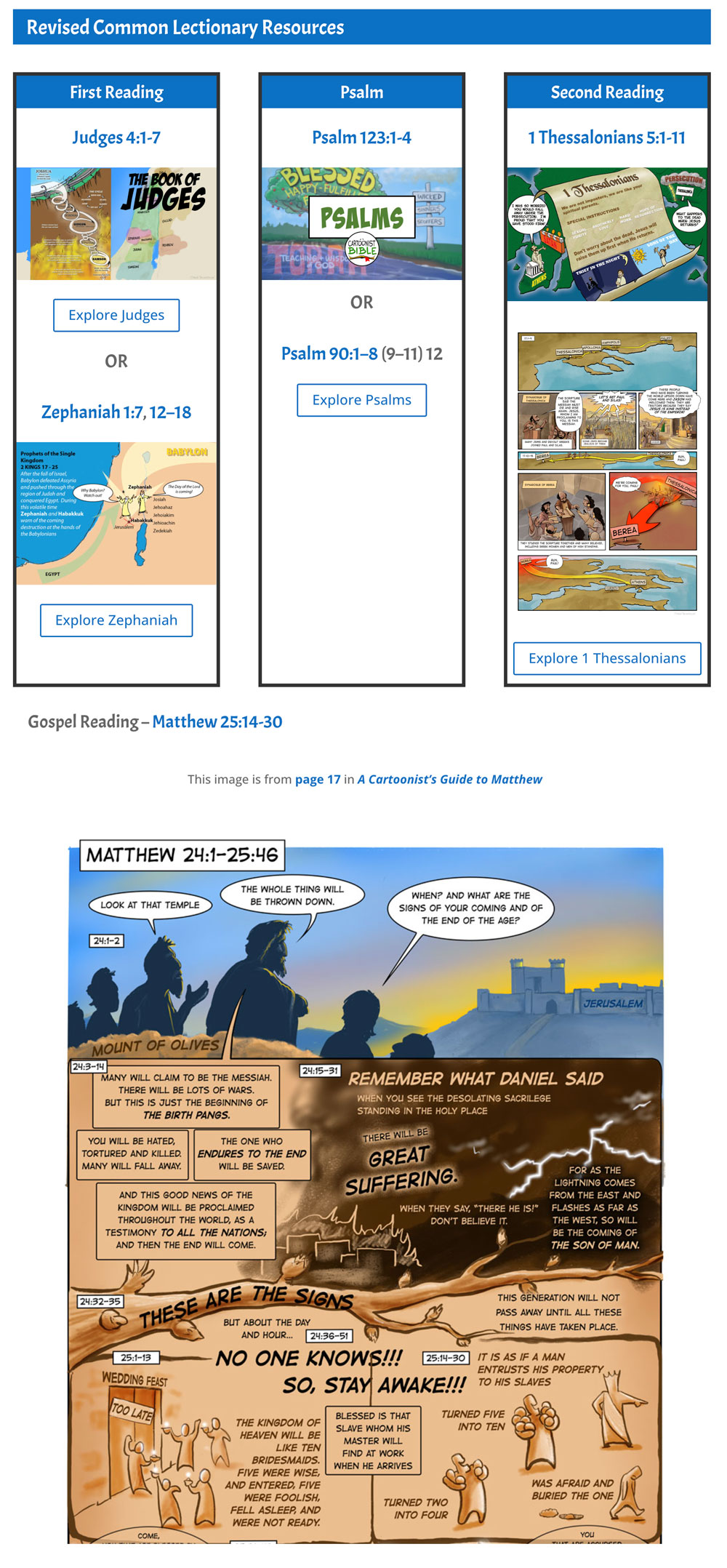
The first context is Matthew 25 and its part of the rhetorical structure of Matthew. The parable of the talents is one small part in a long discourse (The Eschatological Discourse) that begins in the beginning of chapter 24. Jesus and his disciples are walking out of Jerusalem. They have just finished the confrontations with the religious leader in the Temple (the last several weeks of our readings). The disciples were marveling at the big beautiful Temple that Herod had built. Jesus told them, “not one stone will be left here upon another; all will be thrown down.”
We must remember that the New Testament is written in the midst of extreme political tension between the Jewish people and the Roman Empire. Revolution was in the air. A four-year war broke out in 66 C.E. which ended with the destruction of the Temple in 70. The authors of the Gospels knew of this event. Paul saw it coming.
The Gospel of Matthew compiles Jesus’ teachings in this discourse to make commentary on the kind of Kingdom that the world establishes—both in Rome and in a corrupt Jerusalem—and how it stands in contrast to the Kingdom of the Heavens that Jesus proclaimed and practiced.
The second context to keep in mind is the flow of the Revised Common Lectionary and the Church Calendar. Everything is leading up to next week. On November 22 we celebrate the culmination of the church calendar with Christ the King Sunday, aka “The Reign of Christ.” The text for that week is the conclusion of the Eschatological Discourse, Matthew 25:31-46. In that text we draw from the imagery of Daniel 7 where the one like a Son of Man sits on the throne and separates the “sheep from the goats.” That story is a great reversal. The ones rewarded are the ones who paid attention to the lowest members of society—the hungry, thirsty, stranger, naked, and prisoner. Jesus turns the World Power Systems on their head and reminds his disciples of the beatitudes in Matthew 5.
With these two contexts in mind, I am persuaded to interpret the parable of the talents through the lens of Imperial critique. The “man, going on a journey” represents the wealthy and powerful who gain their wealth and power on the back of slaves. This oppressive system rewards those who produce and destroys those who do not. Each slave was given according to his ability to produce. The third man was apparently weak, thus only received one talent. He was rightly afraid of the wealthy tyrant and saved the money, rather than risk losing it. His lack of production was met with wrath and condemnation. Thus perpetuating the world system, “all those who have, more will be given.” The rich get richer while the poor and weak suffer.
That sounds familiar.
The Gospel proclamation this week is that God does not reward the “producers.” God seeks justice, mercy, humility, and righteousness. The Day of the LORD always comes to Empires that build themselves up at the expense of the weak and poor.
Food for Thought
The Narrative Lectionary makes a big jump this week. We move from the Narrative flow of the historical books to the books of the prophets. We made the transition last week by looking at a prophet, Elisha, whose words and works were recorded in 2 Kings. This week we jump to the prophet Micah, who words and work took place during the time of 2 Kings, but are recorded in a book that bears his name.
I encourage you to CLICK HERE to get a general introduction to the genre of literature called The Prophets. Micah served in Jerusalem during a period of time when the Northern Kingdom of Israel was under attack. While Israel was being decimated, the king of Judah, Hezekiah, woke up to the reality of God’s judgment and repented. While this was a good thing for the city of Jerusalem, Micah preached a message that reminded the city to not become smug in its relative safety. They, too, would have their day in court and God had a solid case to bring against them.
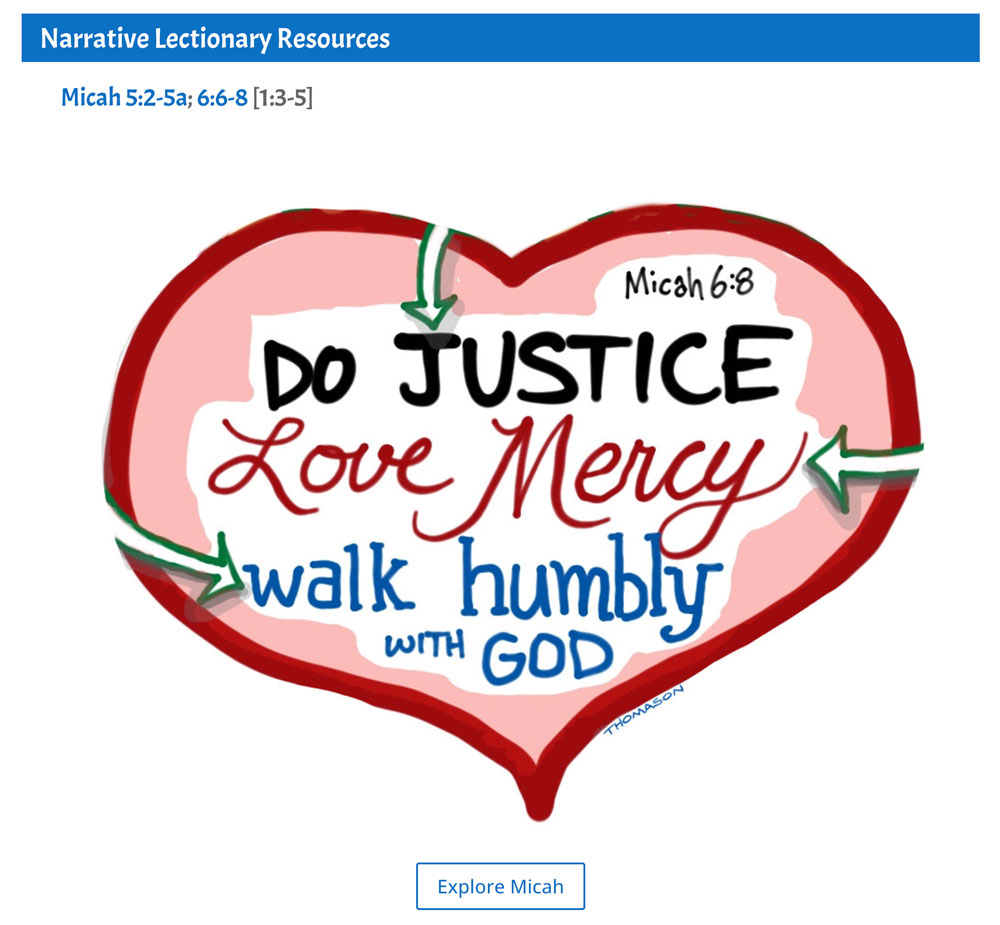
Micah is most famous for saying the thing that summarizes the message of all the prophets. It is quite simple. What does the LORD require of you? To do justice, love mercy, and walk humbly with your God.
Let’s just work on that.
